


Australian Passport Office
A service millions of Australians rely on.
The Australian Passport Office delivers one of Australia's most important government services. More than 3 million Australians apply for a passport every year, while over 8 million people use passports.gov.au to understand the process, renew their passport or replace one from anywhere in the world.
A website built around tasks, not departments.
Improve satisfaction.
Modernise the platform.
Simplify the information architecture.
Reduce pressure on the Contact Centre.
Over two decades, the website had grown to more than 250 pages of policy, legislation and guidance. Finding information became harder, key journeys became longer, and simple tasks often ended in a call to the Contact Centre.
Doghouse was engaged to redesign and rebuild passports.gov.au, transforming a complex government website into a simpler, faster and more accessible service built around the way Australians actually think, search and complete passport tasks.
The project was about more than a new website. It was an opportunity to rethink how Australians access a critical government service, improving journeys for first-time applicants, families, new citizens and Australians overseas while meeting the highest standards for accessibility, usability and performance.
Applying for a passport is rarely routine.
Each person arrives with different questions, different levels of digital confidence and often with significant time pressure.
After more than two decades of incremental change, that front door had become difficult to navigate. More than 250 pages of policy, legislation and guidance had accumulated over time, making it harder for Australians to find information and complete passport tasks online.
When people couldn't find answers online, they turned to the Contact Centre instead. This increased operational demand while highlighting a clear opportunity to improve self-service and help more Australians complete tasks online.
The legacy CMS made content increasingly difficult to manage. As the website expanded, maintaining consistency, governance and content quality became more complex, slowing editorial workflows and increasing publishing effort.
Delivering the platform.
The biggest transformation wasn't visual. It was structural.
We started with a system, not a page.
Colour, type and components defined once, tested for accessibility, then assembled into every page.
Standard applications take at least 6 weeks from the date of your interview.
Validated early. Built with confidence.
The same homepage at three stages of the design process. Each stage was tested and refined with users and stakeholders before moving on, reducing rework and allowing development to start sooner.
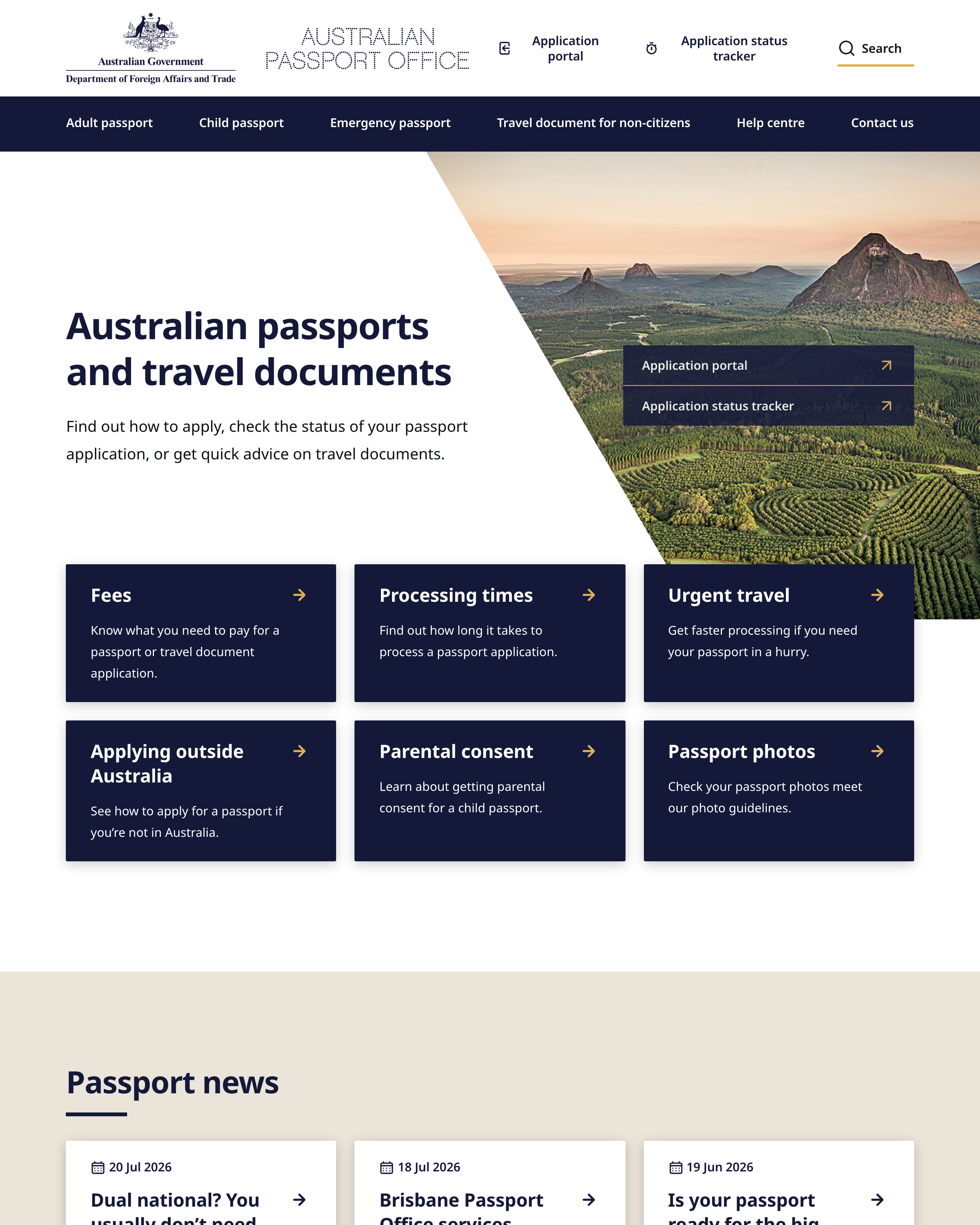
Rather than simply replacing the CMS, we rebuilt the digital experience around how Australians access passport services.
A responsive GovCMS implementation built with Drupal and the Australian Passport Office design system, designed for the performance, accessibility and governance expected of a national government service.
Integration with the Online Passport Application System (OPAS) and the Passport Office feedback platform allowed users to move seamlessly between information and action.
A rebuilt predictive search experience helped users quickly find guidance relevant to their specific circumstances.
Passport fee calculators, processing-time estimates, enquiry forms and key calls to action were embedded directly into relevant customer journeys.
Content migration preserved URLs and SEO while introducing structured publishing workflows, permissions and governance to support long-term content management.
Two-factor authentication for editors and emergency alert capability strengthened operational security and administration.
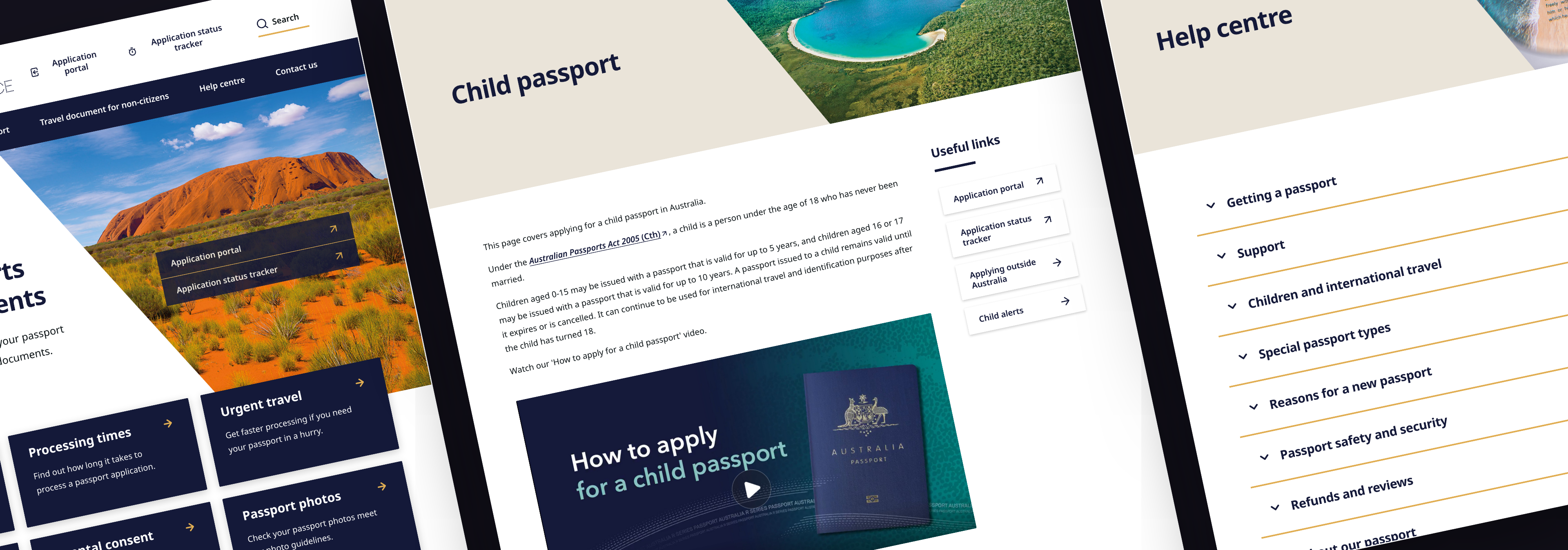
Easier to find. Faster to finish.
The redesigned information architecture, simplified customer journeys and improved search experience made it easier for Australians to find information and complete tasks online. The project delivered measurable improvements in traffic, engagement and discoverability.
Planning your next digital service transformation?
From strategy and research to delivery, we help government build services people rely on.